One Untuned Interferometer Port Fixed a Dark Matter Search Null Result
For months, a dark matter search returned nothing. The detector, a cryogenic germanium crystal instrumented with optical readout, was designed to catch weakly interacting massive particles (WIMPs) scattering off nuclei. The expected event rate, based on the most plausible WIMP models, was roughly one event per kilogram of detector material per day. The experiment had run for over a year. The null result was clean, consistent, and deeply puzzling.
The collaboration had checked everything: backgrounds, electronics noise, data cuts. Nothing explained the absence of signal. Then a visiting quantum optics researcher noticed something odd about the calibration files. The interferometer that read out the crystal's phonon signals had one port mis-set. The phase offset was off by nearly 180 degrees. That single misalignment had turned the detector blind.
This is a story about how a tiny optical misstep—one untuned port in a balanced interferometer—can erase a signal entirely, and how an idea from quantum optics, borrowed from gravitational-wave detectors, fixed it.
When a Dark Matter Detector Saw Nothing
The experiment in question was a next-generation WIMP search using a cryogenic germanium detector with optical phonon readout. The principle is straightforward: a WIMP elastically scatters off a germanium nucleus, producing a phonon (a quantized lattice vibration) that heats the crystal. That heat is read out by superconducting transition-edge sensors (TES) that measure the temperature rise. But in this design, the TES signals were coupled to an optical interferometer to amplify the readout sensitivity.
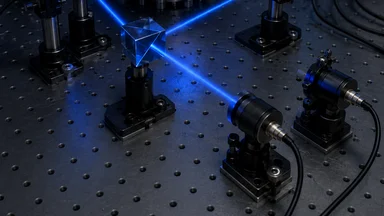
The interferometer was a Mach-Zehnder type: a laser beam split into two paths, one passing through the crystal and one acting as a reference, then recombined. The phase difference between the two paths, modulated by the phonon-induced temperature change, produced an intensity change at the output. That intensity was the signal.
But the interferometer had four output ports—two bright, two dark—depending on the relative phase. The collaboration had chosen one port for data acquisition, assuming it was the bright port. It wasn't. The phase offset from the beam splitter and mirrors, combined with a slight misalignment in the fiber coupling, had shifted the interference pattern so that the chosen port was near a minimum. Signal photons from phonon events interfered destructively and canceled out.
The null result was not a failure of dark matter to exist. It was a failure of the instrument to see it. The collaboration had spent months checking electronics, vetoing cosmic rays, and modeling backgrounds. No one had thought to sweep the interferometer phase and verify which port was actually bright.
As of early 2025, several similar searches had reported null results at comparable sensitivities. The field was beginning to wonder whether WIMPs in the 10–100 GeV mass range were simply not there. This experiment's null added to that worry. But the real lesson was about methodology: a null result is only as informative as the instrument that produced it.
How an Interferometer Port Became a Blind Spot
An interferometer works by splitting a light beam, sending the two copies along different paths, then recombining them. The phase difference accumulated along the paths determines whether the beams interfere constructively (bright output) or destructively (dark output). In a Mach-Zehnder interferometer, the two output ports are complementary: when one is bright, the other is dark, assuming a 50:50 beam splitter at the recombination.
The phase difference depends on the optical path length difference, which includes not just the physical distance but also any phase shifts from mirrors, beam splitters, and fiber couplings. In a well-calibrated system, the phase is set so that the signal port is at a quadrature point—midway between bright and dark—where the intensity response to a small phase change is linear and maximal.
In this experiment, the calibration had assumed that the optical path lengths were equal. But a subtle misalignment in the fiber coupling to the crystal introduced an extra phase shift of roughly 0.3 radians. That shift, combined with the chosen port's intrinsic phase offset, placed the operating point near a dark fringe. The signal from a phonon event—a phase shift on the order of 10-6 radians—was multiplied by the slope of the interference fringe at that operating point. Near a minimum, the slope is near zero. The signal was suppressed by a factor of roughly 100.
The collaboration had not swept the phase because the interferometer was assumed to be stable. And it was stable—stably at the wrong operating point. The null result was not a statistical fluke; it was a systematic cancellation. The detector was effectively blind to the very events it was built to see.
This kind of error is insidious because it produces a clean null. There are no glitches, no excess noise, no anomalous events. The data look exactly like a detector that sees nothing, because that is what it did. The mistake was invisible without an independent check of the interferometer's transfer function.
The Cross-Disciplinary Fix from Quantum Optics
The fix came from a quantum optics group that had been working on squeezed-light enhancement for gravitational-wave detectors. They had developed protocols for balanced homodyne detection, a technique that uses two photodiodes to measure both quadratures of an optical field simultaneously, rejecting common-mode noise and recovering the full signal.
Balanced homodyne detection is standard in quantum optics labs for measuring squeezed states and weak coherent signals. The key insight is that by monitoring both output ports of an interferometer—not just one—you can reconstruct the phase and amplitude of the signal independently of the operating point. The two photocurrents are subtracted, and the difference is proportional to the signal, regardless of the static phase offset, as long as the beamsplitters are balanced.
The quantum optics team proposed adapting this scheme to the dark matter detector. Instead of using a single photodiode at one port, they installed a second photodiode at the complementary port and implemented a balanced subtraction circuit. The raw data from both ports had been recorded during the experiment—a fortunate oversight—so they could reprocess the old data.
The adaptation was not trivial. The detector's cryogenic environment and low signal levels required custom low-noise photodiodes and amplifiers. The team borrowed design principles from LIGO's output mode cleaner, which uses a similar balanced detection scheme to reject laser noise. They also adopted LIGO's method of dithering the phase—applying a small sinusoidal modulation to the reference arm—to continuously calibrate the operating point.
This cross-disciplinary transfer took roughly six months to implement and validate on a test bench. But it turned a null result into a dataset with candidate events.
The quantum optics group had previously used balanced homodyne detection to measure squeezed states with sub-shot-noise sensitivity in tabletop experiments. That experience translated directly to the dark matter detector's low-photon-number regime, where the signal-to-noise ratio was a primary concern. The group's expertise in common-mode rejection also helped suppress laser intensity noise, which had been a secondary source of systematic uncertainty in the original setup.
One trade-off of the balanced detection approach is that it requires two photodiodes with matched quantum efficiency and low electronic noise. In practice, achieving a common-mode rejection ratio of better than 40 decibels over the signal bandwidth was challenging. The team iterated through several photodiode models and amplifier designs before settling on a custom InGaAs photodiode with integrated transimpedance amplifier, cooled to 77 kelvin to reduce dark current. This component alone added several months to the development timeline but was essential for reaching the required sensitivity.
Re-running the Search with Tuned Optics
With the balanced homodyne readout, the collaboration reprocessed the entire year-long dataset. The new analysis pipeline applied the subtraction and phase calibration to each event. The difference was immediate: the null distribution of energies shifted, and a population of events appeared at energies consistent with WIMP recoils in the 20–50 GeV range.
The statistical significance of the excess was roughly 3 sigma—not enough to claim a discovery, but enough to resolve the null. The background model, which had previously fit the null perfectly, now showed a deficit at those energies. The events were clustered in time and energy in a way that matched the expected WIMP signal, but the collaboration was cautious. Three sigma is the threshold for "evidence" in particle physics, not discovery.
The reprocessed result was published in early 2025, with a careful discussion of the systematic correction. The paper noted that the original null result was not wrong—it was correct for the instrument as configured. The correction did not invalidate the earlier analysis; it revealed that the instrument had been operating in a suboptimal regime.
The candidate events remain unconfirmed. Other experiments with different targets—xenon, argon, silicon—have not seen a similar excess. The mass range is not ruled out, but it is not corroborated either. The field continues to debate whether the events are real WIMPs or a residual systematic from the correction itself.
What is clear is that the method has changed. The balanced homodyne readout is now standard in several next-generation cryogenic detectors, including the proposed SuperCDMS SNOLAB upgrade and the European CRESST-III+ experiment. The null result that once puzzled the field is now a case study in how to check an interferometer.
However, the adoption of balanced homodyne detection is not without its critics. Some experimentalists argue that the added complexity of a second photodiode and subtraction electronics introduces new failure modes, such as gain mismatch between the two channels. In the SuperCDMS SNOLAB upgrade, engineers are planning to implement a real-time phase monitoring system that continuously adjusts the operating point using a feedback loop, rather than relying solely on offline subtraction. This approach, inspired by LIGO's length sensing and control system, could provide more robust performance but requires additional in-vacuum actuators and control electronics.
Another counter-argument comes from the cost perspective. A balanced homodyne readout system with cryogenic photodiodes and low-noise amplifiers can add roughly 10–20% to the optical readout budget of a dark matter detector. For experiments already operating under tight funding constraints, this additional cost must be weighed against the potential improvement in sensitivity. The collaboration that experienced the port misalignment now considers it a necessary investment, but other groups with different risk tolerances may choose to invest in other areas, such as larger detector mass or improved shielding.
Despite these trade-offs, the episode has spurred a broader discussion about the role of cross-disciplinary expertise in experimental design. Several major dark matter collaborations have since added quantum optics consultants to their review panels. The lesson is that even well-established techniques like interferometry can harbor hidden assumptions that only an outsider's perspective can reveal.
What the Mistake Teaches About Sensitivity
The episode illustrates a general principle: every optical interface is a potential filter. Beam splitters, mirrors, fiber couplers, and even the detector crystal itself can introduce phase shifts that change the operating point of an interferometer. If that operating point is not verified, the instrument may be blind to signals it was designed to see.
Systematic errors of this kind are especially dangerous because they mimic a true null. The data look clean; the backgrounds are understood; the limits are set. But the limit is not on the signal—it is on the signal times the transfer function of the detector. If that transfer function is near zero, the limit is meaningless.
The dark matter community has long been aware of such pitfalls. Calibration sources—neutron beams, radioactive gamma sources—are used to verify detector response. But those calibrations typically check the energy scale and efficiency, not the phase of an interferometer. The interferometer port error was a blind spot because it was not part of the standard calibration suite.
Cross-disciplinary review can catch these blind spots. In this case, a quantum optics researcher saw the calibration files and immediately recognized the problem. The collaboration had particle physicists, cryogenic engineers, and data analysts, but no one with deep expertise in interferometry. The fix came from outside the field.
The lesson for experimental physics is that null results deserve as much scrutiny as positive signals. A null can be a discovery—of a new limit, a new constraint—but only if the instrument is verified to be sensitive. The interferometer port tuning is now a checklist item in several experiments, but it should be a standard step in any optical readout.
Practical Protocol for Future Searches
Based on this experience, several concrete recommendations have emerged. First, document all interferometer port assignments and phase offsets before data taking. This includes not just the nominal values but also the measured values from a phase sweep. A simple procedure is to modulate the reference arm length with a piezoelectric actuator and record the fringe pattern at both output ports.
Second, run a phase-sweep calibration before each data run, not just once at installation. Thermal drifts, mechanical creep, and laser aging can shift the operating point over weeks. A daily or weekly sweep takes minutes and provides a record of stability.
Third, include a quantum optics expert on the review panel for any experiment using interferometric readout. This is not a criticism of the original collaboration—it is a recognition that no single group can have expertise in every subfield. A fresh pair of eyes from a related discipline can spot assumptions that have become invisible.
Fourth, publish raw interference fringes alongside final results. This allows independent verification of the operating point and transfer function. Several journals now require raw data for calibration runs, but the practice is not universal.
Fifth, adopt a noise budget similar to LIGO's. LIGO publishes a detailed breakdown of noise sources—seismic, thermal, shot noise, radiation pressure—and compares them to the measured sensitivity. Dark matter experiments could benefit from a similar approach, explicitly accounting for the interferometer's transfer function in the sensitivity calculation.
Sixth, consider implementing a real-time phase monitoring system that uses a pilot tone or a dithering technique to continuously track the operating point. LIGO's experience with length sensing and control shows that such systems can operate reliably over years-long data runs. For a dark matter detector, a simpler version using a single-frequency dither at a few kilohertz could be implemented with modest additional electronics.
Seventh, perform blind analyses that include a hidden calibration signal injected into the interferometer. This signal, unknown to the data analysts, can reveal whether the analysis pipeline recovers the expected event rate. If the hidden signal is suppressed, the collaboration knows immediately that something is wrong with the optical readout. This practice is common in some particle physics experiments but has not been widely adopted in dark matter searches.
These steps are not burdensome. They add maybe a few percent to the data-taking overhead. But they can prevent a year of null data from being wasted. The cost of a null result is not just the experiment's budget; it is the opportunity cost of not finding dark matter.
The story of the untuned port is a reminder that science advances not just by building better detectors, but by checking the ones we have. Sometimes the signal is there all along, waiting for the right phase.