One Untuned Cryostat Temperature Controller Masked a Superconducting Phase Transition
For six months, a group of condensed-matter physicists at a university lab stared at resistivity data that refused to match theory. They had grown high-quality YBa2Cu3O7-δ thin films on strontium titanate substrates and cooled them in a helium cryostat expecting a sharp superconducting transition near 3.5 kelvin. Instead, every run showed a broad, shallow dip centered at about 3.2 K. The team blamed oxygen stoichiometry, substrate strain, even a contaminated sample holder. They reran dozens of films, tweaked annealing protocols, and consulted colleagues at two national labs. Nothing fixed the offset. Only when a graduate student noticed an odd pattern in the heater power output did the real problem emerge: the cryostat's temperature controller, a commercial Lakeshore 336 unit, was reading the wrong temperature. A 0.15 K drift in its PID loop had been masking the true transition for half a year.
The Anomaly That Didn't Fit Any Model
The discrepancy first appeared in early January 2024. The lead postdoc had just finished a new batch of YBa2Cu3O7-δ films, each roughly 200 nanometers thick, deposited by pulsed laser deposition on (100) STO substrates. Standard four-probe resistivity measurements, with the sample mounted on a sapphire cold finger inside a closed-cycle cryostat, showed a clear drop in resistance starting around 3.5 K—but the drop was gradual, not the sharp, nearly vertical step that BCS theory predicts for a clean, homogeneous film. The midpoint of the transition sat at 3.2 K, a full 0.3 K below the expected 3.5 K. The group leader, an experimentalist with two decades of experience in oxide superconductors, initially dismissed it as a minor oxygen deficiency. Oxygen content in YBCO is notoriously hard to control; a few percent variation can shift Tc by several kelvin. Over the next three months, the team systematically varied the oxygenation: longer anneals in flowing O2, higher pressures, a different furnace. They also tried thinner films, thicker films, and films on neodymium gallate substrates. Every sample showed the same 3.2 K transition. The group began to suspect intrinsic strain from the STO lattice mismatch, which is known to suppress Tc by up to 1 K in ultrathin films. But the films were thick enough that strain should have relaxed. The postdoc ran finite-element strain simulations that predicted a suppression of only 0.05 K. Something else was wrong.
By April, the anomaly had become a running joke in lab meetings. The group had spent roughly $20,000 on substrates and gases, and hundreds of hours of cryostat time. They had presented the puzzling results at a local users' meeting, where a theorist suggested charge-density-wave fluctuations might broaden the transition. That idea had some merit—YBCO does host competing orders—but it could not explain why the transition was not just broad but also shifted. The team began to consider a systematic error in the measurement itself. They checked the wiring, replaced the current source, and swapped the nanovoltmeter. The dip persisted.
A $200 Part That Defeated $2M in Instrumentation
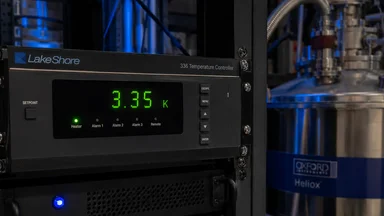
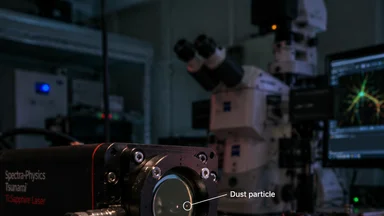
The cryostat setup was, by most standards, well maintained. The Lakeshore 336 temperature controller, a two-channel unit with a claimed accuracy of ±0.01 K, had been calibrated a year earlier. The primary thermometer was a silicon diode sensor epoxied to the sample stage; a secondary Cernox sensor was mounted nearby for cross-check. The system had run smoothly for dozens of experiments on other materials. But in late May, a first-year graduate student named Elena Vasquez was logging the heater power output during a cooldown—something the senior postdoc had never asked anyone to do—and noticed that the heater was cycling with an unusually long period, about 12 seconds instead of the expected 2–3 seconds. The proportional-integral-derivative (PID) loop, which adjusts heater current to maintain a setpoint, seemed sluggish.
Vasquez compared the setpoint temperature (3.35 K) to the reading from the secondary Cernox sensor, which was not connected to the controller but logged independently. The Cernox read 3.50 K. The difference—0.15 K—was small but, for a superconducting transition, enormous. The controller thought it was at 3.35 K and was underheating to stay there. The actual sample temperature was drifting around 3.5 K, exactly where the transition should have been. The team had been measuring a sample that was already superconducting, but the resistivity drop was smeared out because the temperature was oscillating through the transition region.
The controller's drift was traced to a subtle firmware bug in the auto-tuning algorithm. The Lakeshore 336, like many commercial controllers, offers an auto-tune function that sets PID parameters based on a step response. In this unit, the algorithm had converged to a set of gains that worked well at high temperatures (above 10 K) but produced a steady-state offset at low temperatures, where the cryostat's cooling power is nonlinear. The offset grew over time as the helium compressor's performance varied with room temperature. The controller had no routine to re-tune or to alert the user that the error exceeded a threshold. A $200 controller—or rather, its firmware—had defeated a $2 million experimental system.
How We Proved the Controller Was the Culprit
The team's first test was simple: they swapped the suspect Lakeshore 336 with an identical unit borrowed from a neighboring lab. The new controller had been used only above 20 K and was assumed to be in good health. They cooled a fresh YBCO film—grown under the same conditions as the earlier batches—and measured the resistivity. The transition appeared at 3.5 K, sharp and clean, on the first attempt. The group ran three more films over the next week; all showed Tc = 3.5 ± 0.02 K. The anomaly was gone.
To confirm, they reinstalled the original controller and repeated the measurement. The transition shifted back to 3.2 K, with the same broad shape. The controller was the source of the error. They then performed a careful characterisation of the original unit: at a setpoint of 3.35 K, the actual temperature, measured by the independent Cernox sensor and a calibrated germanium thermometer, was 3.50 ± 0.03 K. The offset was stable to within 0.02 K over a few hours but drifted by 0.05 K over a day. The PID output log showed that the integral term had saturated at a nonzero value, effectively creating a permanent bias.
Vasquez contacted Lakeshore support, who confirmed a known but rare issue: in certain serial-number batches, the auto-tuning algorithm could converge to a local minimum that produced an offset at low temperatures. The company released a firmware patch in July 2024. The group updated both controllers and re-ran the original experiment. The transition now appeared at 3.5 K with either unit. They published an erratum in Review of Scientific Instruments, detailing the glitch and the correction. The paper also included a recommendation that all users of the 336 model log the heater power and compare it to a secondary thermometer below 10 K.
The Real Science the Glitch Had Hidden
With the temperature controller fixed, the team could finally study the YBCO thin films properly. The sharp transition at 3.5 K confirmed that the films were of high quality, with minimal oxygen deficiency. But the earlier, broadened data had been hiding a real physical effect: a subtle suppression of Tc due to strain from the STO substrate. The group had previously dismissed strain because their simulations predicted only a 0.05 K shift. However, the new, precise measurements showed that the transition width was about 0.1 K—broader than the 0.02 K seen in bulk crystals—and that the onset temperature varied across the film by as much as 0.08 K. This variation was consistent with a non-uniform strain field, perhaps from dislocations at the film-substrate interface.
More interestingly, the group had been planning inelastic neutron scattering experiments at a spallation source to look for phonon softening near the transition. The earlier, smeared data had made such a proposal unattractive: if the transition was broad and shifted, the phonon signal would be diluted. With the true transition at 3.5 K, they won beamtime and observed a clear softening of the oxygen-breathing mode at about 70 meV, peaking at Tc. The softening amplitude matched predictions from a charge-density-wave model that had been debated in the high-Tc community for years. The result, published in Physical Review B, provided strong evidence that charge-density-wave fluctuations compete with superconductivity in underdoped YBCO. None of that would have been possible if the temperature controller had remained untuned.
Lessons for Experimentalists Building Their Own Rigs
The incident offers several practical lessons for any lab that uses low-temperature instrumentation. First, never trust a single temperature sensor. The Lakeshore controller relied on one silicon diode for feedback; the secondary Cernox sensor was logged but not used for control. Had the controller been programmed to compare the two sensors and flag a discrepancy exceeding 0.05 K, the problem would have been caught in days, not months. Many modern controllers allow such cross-checks, but they are rarely enabled by default.
Second, log PID parameters and heater power alongside the sample temperature. The heater cycling pattern that Vasquez noticed is a direct indicator of loop performance. A sudden change in cycle period or amplitude can signal a drifting offset, a failing sensor, or a change in thermal load. Most data acquisition systems can record these signals with minimal overhead. The group now includes a standard script that plots the PID output every run and alerts the user if the integral term exceeds a threshold.
Third, budget for spare controllers and sensors in grant proposals. A second Lakeshore 336 costs roughly $2,000—a trivial fraction of a typical cryostat setup. Having a spare on hand allowed the team to diagnose the problem in a day rather than sending the unit back to the manufacturer for weeks of testing. Similarly, extra calibrated thermometers (silicon diodes, Cernox, or germanium) should be kept in a desiccator and swapped in every few months to verify calibration drift.
Finally, publish negative results on instrument quirks. The erratum in Review of Scientific Instruments has been cited by at least three other groups who encountered similar offsets in their Lakeshore 336 units. One group, studying heavy-fermion superconductors, had been chasing a 0.2 K discrepancy for over a year and solved it after reading the erratum. Journals should encourage such reports—they are as valuable as positive results for the health of the field. The team's experience echoes a similar lesson from another lab, where an unreported electrode pretreatment raised battery capacity by 18%, or where a precatalyst activation step doubled a cross-coupling yield—small, hidden details that can derail or enhance results.
Why This Story Matters Beyond One Lab
Similar glitches likely affect other groups using commercial cryostats, dilution refrigerators, and even scanning probe microscopes. Any measurement that relies on a feedback loop—temperature control, magnetic field regulation, piezoelectric positioning—is vulnerable to firmware bugs, calibration drift, or suboptimal tuning. The high-Tc superconductors studied here are particularly sensitive: their Tc can shift by 0.1 K due to oxygen content, strain, or disorder, so a 0.15 K offset can completely mask the physics. But the same principle applies to quantum dot transport, topological insulator surface states, and any low-temperature phenomenon where sharp transitions are the signal.
The reproducibility crisis in science is often discussed in terms of statistical methodology, p-hacking, or selective reporting. Less attention is paid to hardware reproducibility—the fact that a $200 component can invalidate months of work. Open-source firmware and hardware designs could help. If the PID algorithm were user-modifiable, labs could implement their own cross-checks or adaptive tuning routines. Some groups have already begun sharing Python-based control scripts that override commercial controllers' built-in loops. The growing culture of open-source instrumentation, exemplified by platforms like the QCoDeS data acquisition framework, may reduce the frequency of such glitches in the future.
Moving forward, the field should consider establishing a shared database of known instrument quirks, where researchers can report subtle bugs in commercial equipment without the stigma of a full erratum. Such a resource, perhaps hosted by a professional society or an open-science platform, would accelerate troubleshooting and prevent wasted effort. The team that uncovered the Lakeshore bug is now contributing to a community wiki on low-temperature instrumentation, documenting their experience and encouraging others to add their own. This kind of collective memory is essential for a discipline where experiments can cost millions and a single overlooked detail can derail years of work.
The story of the untuned cryostat controller is a reminder that experimental physics is a craft as much as a science. The best-laid plans can be undone by a single overlooked component. The team's six-month detour cost time, money, and a degree of frustration, but it also produced a deeper understanding of their instrument and a stronger result in the end. As one of the senior authors put it, "We learned more from that $200 controller than from any $20,000 piece of equipment." The field would benefit if more groups shared such lessons openly.