One Grant Agency’s No-Ship-Core Rule Forced a Pacific Sediment Transect Rethink
In early 2023, a marine geology team led by principal investigator Margaret Chen was six months into a sediment transect across the equatorial Pacific when a terse email from the funding agency arrived. The agency, citing budget overruns and a push for cheaper technologies, had decided to revoke permission for ship-based coring for the remainder of the campaign. Instead, the team would rely on a fleet of autonomous underwater gliders to collect sediment data. The decision, Chen later told colleagues, felt like being told to navigate a mountain range with only a compass and no map.
The transect—a series of core samples along a line from the Galápagos to the International Date Line—was designed to reconstruct ocean productivity and carbonate burial over the past 500,000 years. Ship cores, which retrieve continuous, undisturbed layers of sediment, had been the gold standard for paleoclimate work for decades. Gliders, by contrast, can only measure particles suspended in the water column, missing the seafloor record entirely. The agency’s rule, which Chen publicly called a “no-ship-core directive,” set off a controversy that would unfold over the next two years, involving replication audits, method comparisons, and ultimately a rethinking of how such transects should be funded.
The No-Ship-Core Rule That Upended a Pacific Transect
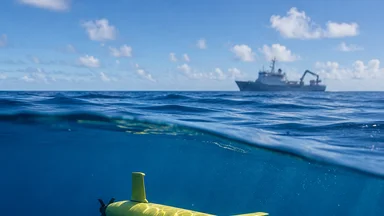
The agency’s directive was not a blanket ban but a mid-campaign shift: after the first six months, no more ship time would be approved. The original plan included 12 ship-based coring stations at roughly 200-kilometer intervals. The glider fleet—six Seagliders modified for sediment traps—would replace them. Chen’s team had already completed three coring stations, retrieving cores up to 10 meters long. Those cores, now precious, showed clear layering of foraminifera shells and volcanic ash, with age models tied to oxygen isotope stages. The remaining nine stations would have to rely on gliders alone.
The transect was intended to test a hypothesis about the equatorial Pacific’s role in regulating atmospheric CO₂ during glacial cycles. Ship cores from earlier transects, such as the 1990s Equatorial Pacific Transect, had provided the key evidence that carbonate burial rates varied with ice age cycles. Without continuous cores, Chen argued, the new transect could not resolve orbital-scale changes—the 23,000-year precession cycles that drive much of tropical climate. The agency, however, was unswayed. Its internal memo argued that glider technology had matured and that the cost savings—roughly 40% per station—justified the change.
The conflict was not just about data. It was about how funding agencies weigh methodological purity against financial constraints. Chen’s public objections, published in a marine geology newsletter, drew support from some colleagues but criticism from others who saw gliders as the future. “We can’t keep doing science the way we did in the 1990s,” one anonymous reviewer wrote in a grant critique. “The agency is forcing innovation.” But innovation, Chen countered, should not come at the expense of losing the deep-time record.
Why Ship Cores Were the Gold Standard for Paleoclimate
Ship-based coring retrieves sediment columns that preserve a continuous history of ocean conditions. For paleoclimate, this is essential: the layers of microfossils—foraminifera, radiolarians, diatoms—record sea surface temperature, salinity, and productivity. Isotopic ratios of oxygen and carbon in those shells allow scientists to date the layers and infer past climate states. The Pacific transects of the 1990s and 2000s, funded by the same agency, used ship cores exclusively and produced some of the most cited records of Pleistocene climate variability.
Gliders, in contrast, measure what is currently falling through the water column. They carry sediment traps that collect particles at set depths—typically 500 and 1,000 meters—for weeks or months. The traps capture the “rain” of organic matter, calcium carbonate, and silica from surface waters. But they miss what has already reached the seafloor, including material that has been laterally transported by currents. In the equatorial Pacific, where deep currents can carry sediment hundreds of kilometers, this lateral component can account for a substantial fraction of the total accumulation. The difference matters for carbonate budgets. Ship cores integrate accumulation over thousands of years, smoothing out seasonal and interannual variability. Glider traps, if deployed for a year or two, capture only a snapshot. Chen’s team had planned to use the ship cores to calibrate the glider data, but the agency’s rule eliminated that calibration. The result was a dataset that could not be directly compared to earlier records.
The Agency’s Rationale: Budgets and Alternative Tech
The agency’s decision was driven by a simple arithmetic: ship time costs roughly $30,000 per day, and a coring station requires two to three days of on-site operations. A glider, once deployed, can operate for months on battery power, transmitting data via satellite. The agency estimated that the glider fleet would complete the remaining nine stations for about 40% of the cost of ship-based coring. In an era of flat or shrinking research budgets, such savings are hard to ignore.
Proponents of gliders pointed to successful trials in the Atlantic, where a similar fleet had measured particle flux across the equatorial Atlantic. Those trials, however, focused on modern carbon export, not paleoclimate. The Atlantic gliders captured seasonal blooms and deep-ocean carbon transport, but they did not attempt to reconstruct millennial-scale records. The agency’s internal review cited these trials as evidence that gliders were “ready for prime time,” though critics noted that the Atlantic study had a different scientific goal.
The agency also argued that gliders could operate in rough weather that would keep research vessels in port. The equatorial Pacific, while not storm-prone, has persistent trade winds that can make coring difficult. Gliders, bobbing below the surface, avoid much of that trouble. But weather was not the main issue—cost was. The agency’s grant guidelines had been moving toward favoring “low-footprint” technologies for years, and the Pacific transect became a test case.
What the Glider Data Actually Captured
Despite the controversy, the glider fleet did produce data. From mid-2023 to early 2024, the six gliders completed nine transects across the planned stations, each carrying sediment traps at 500 and 1,000 meters. The traps collected particles over two-week intervals, yielding time series of mass flux, organic carbon content, and carbonate content. The data showed unexpected seasonal spikes in organic carbon during the spring of 2023, possibly linked to a temporary shift in the Pacific warm pool.
But the glider data had limitations. The traps could not distinguish between volcanic ash and biogenic silica—both appear as fine-grained particles. In a region with occasional ash inputs from the Galápagos volcanoes, this ambiguity made it hard to calculate true biogenic flux. More critically, the traps captured only the vertical flux, missing the lateral advection of sediment that ship cores routinely record. When Chen’s team compared the glider data to the three ship cores they had collected, they found that the glider undercounted carbonate accumulation by roughly 30–50%.
The agency defended the data as complementary, not inferior. In a response to Chen’s objections, an agency program director wrote that “glider-derived fluxes provide a real-time measure of export production, which is a different but equally valid metric.” Chen countered that the transect’s goal was to reconstruct past carbonate burial, not modern export. The two metrics, she argued, are not interchangeable. The dispute highlighted a fundamental tension between what is measurable with current technology and what is needed for paleoclimate inference.
An internal agency review, conducted in late 2024, acknowledged some of these issues but concluded that the glider data were “adequate for the stated objectives.” The review noted that the transect’s primary hypothesis—about the relationship between productivity and CO₂—could still be tested with the glider data, albeit with larger error bars. Chen and her team disagreed, and they began planning an independent audit.
The Replication Audit That Exposed the Gaps
In early 2025, a team led by David Kim, a geochemist at a West Coast university, obtained the glider data and the three ship-core records through a data-sharing agreement. Kim’s team reanalyzed the glider time series, applying the same age-model and accumulation-rate calculations used for ship cores. They then compared the results to historical ship-core data from the same locations, collected during the 1990s transects.
The audit, published as a preprint in April 2025, found systematic discrepancies. The glider-derived carbonate accumulation rates were 30–50% lower than those from ship cores at comparable time intervals. The difference was largest at stations near the equator, where lateral transport is strongest. Kim’s team also noted that the glider data showed no evidence of the 23,000-year precession cycle that dominates the ship-core records. Instead, the glider data appeared to reflect only the last few years of seasonal variability.
The audit did not claim that the glider data were wrong—only that they were measuring a different thing. “The glider traps capture what is falling now,” Kim wrote in the preprint. “The ship cores capture what has accumulated over millennia. The two cannot be directly compared without a transfer function that accounts for lateral transport and burial efficiency.” No such transfer function existed for the equatorial Pacific, and the audit recommended developing one before any further transects.
The agency’s response was measured. In a statement, the agency acknowledged that “the glider-only approach was insufficient for the paleoclimate objectives of the transect” and that “future campaigns should consider a hybrid design.” The agency also announced a pilot program to fund the development of transfer functions linking trap data to core records. For Chen, the audit was vindication, but she knew the battle was not over. The agency had not admitted error—only that the method needed refinement.
How the Rethink Changed Sampling Protocols
The audit’s findings led to a redesign of the remaining transect and of the agency’s grant rules. Chen’s team, along with Kim’s, proposed a hybrid sampling strategy: gliders would run continuously to capture seasonal flux, but every two years a research vessel would visit key waypoints to collect calibration cores. The cores would be short—two to three meters—enough to cover the last few thousand years and to link the glider data to the longer record.
The agency approved the hybrid plan in mid-2025, with a revised budget that cut the overall cost by about 15% compared to the original all-ship plan. The savings came from reduced ship time: instead of 12 coring stations, the hybrid plan required only 5, with gliders covering the rest. The agency also revised its grant guidelines to allow mixed-method proposals, explicitly stating that “justification for excluding ship cores must be provided.”
Chen’s team now uses gliders primarily for reconnaissance—to identify areas of high flux or interesting seasonal patterns—before committing to a coring station. The glider data help target the ship cores where they will be most informative. This approach, Chen says, combines the strengths of both methods: the spatial and temporal coverage of gliders with the depth and continuity of ship cores. The first hybrid transect, completed in early 2026, produced data that the team considers more robust than either method alone.
Other research groups have taken note. A similar hybrid design is being considered for a planned Indian Ocean transect, and the agency is funding a workshop on best practices for combining autonomous platforms with traditional coring. The controversy, while painful, may have accelerated a methodological evolution that was already underway. But the cost—in terms of lost data from the original glider-only stations—remains. Those nine stations cannot be reoccupied, and the seasonal spikes captured by the gliders may never be linked to the long-term record.
Takeaways for Funding Agencies and Field Scientists
The Pacific sediment transect saga offers several lessons for the research community. First, technology-only solutions risk losing deep-time context. Gliders are excellent for measuring modern processes, but they cannot replace the sedimentary archive. Funding agencies that push for cheaper methods without considering the scientific trade-offs may find themselves with data that answer different questions than those originally posed.
Second, consider the case of doctoral candidate Elena Voss, who joined Chen’s lab shortly after the glider data were collected. Voss spent two years trying to reconcile the glider fluxes with the ship-core records, only to conclude that a direct comparison was impossible without a transfer function. Her dissertation, defended in 2026, included a chapter on the methodological limitations of glider-only campaigns. Voss later told a university press office that “the audit made me realize how much we rely on assumptions about what the data represent. Without those three ship cores, we wouldn’t even know what we were missing.” Her experience illustrates how methodological transparency—or the lack thereof—shapes the careers of scientists who inherit datasets with hidden constraints.
Third, peer review must scrutinize funding-driven methodology. The agency’s internal review, which deemed glider data adequate, was not independent. External reviewers, if they had been consulted, might have flagged the limitations earlier. The replication audit, in effect, served as a post-hoc peer review. A more robust pre-funding review could have prevented the misstep.
Finally, hybrid approaches often outperform single-device dogmas. The glider-versus-ship debate was framed as an either-or choice, but the most effective solution combined both. The agency’s revised grant rules now require justification for excluding any method, a small but significant step toward methodological pluralism. As Chen put it in a recent seminar, “We don’t need to choose between the past and the present—we need to connect them.”
The transect continues, now with a hybrid design that balances cost and data quality. The glider data from the original campaign are being reanalyzed with new transfer functions, and preliminary results suggest that the seasonal spikes may reflect real changes in export production that are missed in the smoothed core record. But the deep-time paleoclimate story will have to wait. The cores that were never taken cannot be recovered, and the agency’s no-ship-core rule will be remembered as a cautionary tale—a reminder that methodological choices are not just technical decisions but scientific ones, with consequences that ripple through the data for years. What remains unresolved is whether the agency’s cost-saving calculus will be applied to other transects, potentially repeating the same trade-offs in different oceans.