Thailand Southern Rail Lodging Math Favors Night Trains Over Midday Hostel
Every budget traveler who has stared at a map of southern Thailand knows the dilemma: do you break the journey with a midday hostel stopover, or push through on an overnight train? The numbers, when you run them, lean decisively toward the sleeper. On the Bangkok–Surat Thani corridor alone, night train fares run roughly 300–500 baht, while a hostel dorm in Surat Thani averages 250–350 baht per night. That looks close until you factor in the lost half-day of checking in and out, the meal costs, and the simple fact that daytime travel eats 8–10 hours you could spend exploring. The arithmetic repeats itself on every southern route, and the night train consistently comes out ahead.
Why Night Trains Beat Midday Hostels on the Southern Rail Line
The core arithmetic is straightforward. A second-class sleeper from Bangkok to Surat Thani costs roughly 400–600 baht for an air-conditioned berth, or about 300–450 baht for a fan carriage. That fare buys you both transport and a night's accommodation. A hostel dorm in Surat Thani, near the train station, runs 250–350 baht per night, but you still need to buy a separate daytime train ticket—around 250–400 baht for the same distance. The combined cost of a daytime train plus a hostel bed is 500–750 baht, versus 300–600 baht for the sleeper. The night train saves 200–150 baht, and that is before you account for the value of time.
Time is the hidden variable. A daytime train from Bangkok to Surat Thani takes roughly 8–10 hours. You arrive in the late afternoon, check into a hostel, maybe wander the streets for an hour or two, then sleep. The next morning you check out and continue south. You have effectively burned an entire day for a transit hub that offers little reason to linger. The night train departs around 6–8 PM and arrives 6–8 AM. You sleep through the journey, wake up at your destination, and step directly onto a bus or ferry. The day is yours.
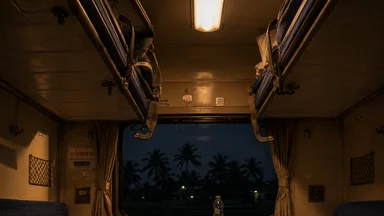
Comfort is the trade-off. A sleeper berth is not a hotel bed. The mattress is thin, the blanket is often a single sheet, and the carriage can be noisy. Earplugs and a sleep sheet are essential. But for one night, most travelers adapt. The alternative—a hostel bunk in a shared dorm—is not exactly luxurious either. And the hostel requires you to haul your bag from the train station, find the place, check in, and reverse the process the next morning. The night train eliminates that friction.
There is also a psychological benefit. Arriving in the morning feels like a fresh start. You are not dragging yourself off a train at 3 PM with half the day gone. You can drop your bag at a guesthouse, grab breakfast, and be on a longtail boat to Khao Sok by 9 AM. The night train turns transit into downtime.
The True Cost of a Midday Hostel Stopover in Surat Thani
Surat Thani is a transit hub, not a destination. Most travelers pass through on their way to the islands—Koh Samui, Koh Phangan, Koh Tao—or to Khao Sok National Park. The city itself has a few temples and a night market, but few would call it a highlight. Yet every day, budget travelers book a hostel near the train station, spend 250–350 baht on a dorm bed, and then add another 200–300 baht for meals, storage fees, and maybe a cheap pad thai from a street stall. That is 500–650 baht for 12 hours of essentially nothing.
The stopover also costs you half a day. You arrive in Surat Thani around 2–4 PM on a daytime train. By the time you find your hostel, check in, and drop your bag, it is 3–5 PM. You might have three or four hours of daylight left, but most sights are a songthaew ride away, and the heat is punishing. You end up sitting in a 7-Eleven parking lot drinking a Chang, waiting for dinner. The next morning, you check out by 10 AM, store your bag, and kill another two hours before your onward bus or ferry. The stopover has consumed 18 hours of your trip for very little return.
Compare that to the night train. You board in Bangkok at 7 PM, eat a simple meal from the food cart, read a book, and fall asleep. When you wake up, you are in Surat Thani. You walk off the platform, buy a ticket for the 8 AM bus to Khao Sok, and are on the road by 8:30. No hostel, no wasted time, no extra cost. The savings are not just monetary; they are temporal.
Of course, some travelers prefer the stopover for a reason. If you have been on the road for weeks and need a real shower, a proper bed, and a quiet room to recharge, a hostel in Surat Thani can be a welcome reset. The night train's shared toilet and cramped sink do not compare. But for most trips of a week or two, the math favors the train.
Night Train Logistics: What the Timetables Don't Tell You
The State Railway of Thailand runs several overnight services from Bangkok's Hua Lamphong Station to Surat Thani. The most popular is the Special Express No. 85, departing at 7:30 PM and arriving in Surat Thani at 7:15 AM. Another option is the Rapid No. 167, which leaves at 6:30 PM and arrives at 6:45 AM. Second-class sleeper carriages come in two variants: fan and air-conditioned. The fan carriages are cheaper, around 300–450 baht, but can be stuffy in the humid night. A/C carriages, at 400–600 baht, are more comfortable but sometimes over-chilled. Bring a light jacket or a long-sleeve shirt.
Book at least 24 hours ahead. Walk-up tickets are often sold out, especially during high season (November–February). Hua Lamphong has a dedicated booking counter for advance sales. You can also book online through the official railway website or third-party agents, but they add a small fee. The station itself is worth a visit—a grand 1916 building with a high arched roof and a sense of history. Arrive an hour early to secure your berth and buy snacks from the vendors outside.
The train's food cart serves basic Thai dishes—fried rice, noodle soup, omelets—for about 40–60 baht. The quality is decent, but the portions are small. Pack backup snacks: instant noodles, dried fruit, and a water bottle. The train also has a drinking water dispenser, but it is often lukewarm. Earplugs are non-negotiable. The carriage is not silent: babies cry, snorers snore, and the train's horn blares at crossings. A sleep sheet is also wise; the provided blanket is thin and may not be freshly laundered.
Arrival in Surat Thani is smooth if you are prepared. The station is small, with a ticket office, a few shops, and a taxi stand. Tuk-tuks and songthaews wait outside, but agree on the fare before boarding—50–100 baht to the bus terminal is standard. If you are heading to Khao Sok, the bus leaves from the main terminal every hour or so. The journey takes about 1.5–2 hours and costs roughly 100–150 baht. The night train's timing aligns perfectly with the morning bus schedule.
Guesthouse vs. Hostel: The Real Trade-Offs for Budget Travelers
Once you reach your destination, the lodging decision shifts from train versus hostel to guesthouse versus hostel. In Khao Sok, a private room in a guesthouse runs 500–800 baht per night. A hostel dorm bed is 250–400 baht. The guesthouse offers privacy, quiet, and often a porch or balcony where you can sit and watch the jungle. The hostel forces social noise—dormitory chatter, early risers rustling bags, late-night arrivals. For solo travelers who value sleep, the guesthouse is worth the premium.
For two travelers, the math flips. A guesthouse room at 600 baht split two ways is 300 baht per person—cheaper than two dorm beds at 350 baht each. Couples and duos should always check guesthouse rates first. Hostels often charge per bed, not per room, so a private double at a guesthouse can be the better deal. The quality varies, though. Some guesthouses are basic wooden bungalows with cold-water showers and mosquito nets. Others are modern concrete rooms with A/C and hot water. Read recent reviews, not just star ratings.
Privacy versus price is not a dogma; it depends on trip length. On a three-day trip, a hostel saves maybe 200 baht per night, or 400 baht total. That is a single meal at a decent restaurant. If the hostel is noisy and you sleep poorly, you have wasted the savings in lost energy. On a two-week trip, those nightly savings add up to 2,800 baht—enough for a nice dinner or a massage. The longer the trip, the more the hostel makes sense, provided you can tolerate the dorm environment.
There is also the social factor. Hostels attract travelers who want to meet people. If you are solo and looking for trekking partners or a dinner companion, a hostel dorm is the easiest way. Guesthouses are quieter; you might not exchange a word with your neighbor. For some, that is a feature. For others, a bug. Know yourself before you book.
Three-Day Southern Loop: A Humane Pace Without Hostel Hopping
A three-day southern loop can cover Bangkok, Khao Sok, and back without a single midday hostel stopover. Day 1: board the night train from Bangkok to Surat Thani around 7 PM. Sleep in the second-class A/C sleeper. Arrive in Surat Thani at 7 AM on Day 2. Catch the 8 AM bus to Khao Sok, check into a guesthouse by noon. Spend the afternoon on a lake tour or a short jungle trek. Day 3: morning exploration, then the afternoon bus back to Surat Thani for the 7 PM night train to Bangkok. Arrive in Bangkok at 7 AM on Day 4.
Total lodging cost: two nights on the train (roughly 800–1,200 baht for both berths, depending on A/C choice) plus two nights in a guesthouse (1,000–1,600 baht). That is 1,800–2,800 baht for three days of travel. If you had used hostels for two nights instead of the guesthouse, you might save 200–400 baht, but you would also need to factor in a hostel night in Surat Thani on Day 1 if you took a daytime train—adding another 250–350 baht and losing half a day. The night train eliminates that.
The pace is humane. You are not racing from one sight to the next. You have time to sit at a lakefront restaurant, watch the limestone karsts change color at sunset, and sleep in a real bed for two nights. The train becomes part of the experience, not just a transfer. Many travelers find the rhythmic clatter of the rails soothing, a lullaby that marks the transition between city and jungle.
This loop works for other destinations too. Swap Khao Sok for Trang or Chumphon, and the same logic applies. The southern rail line is a spine, and the night train is the most efficient way to travel along it without burning daylight or money on unnecessary stopovers. For more on train routes, see our Thailand train guide.
Seven-Day Itinerary: Rail Plus Island Ferry, No Dorm Drift
For a longer trip, the night train strategy scales. Consider a seven-day itinerary: night train from Bangkok to Surat Thani, then a ferry to Koh Samui. Spend three nights in a bungalow on Samui—800–1,200 baht per night for a basic room near the beach. Take the ferry back to the mainland, then a night train from Surat Thani to Trang. Stay two nights in a Trang guesthouse—500–700 baht per night—exploring the nearby islands or the Trang River. Finally, a night train back to Bangkok.
In this itinerary, the night trains save you two hostel nights. Without them, you would need to book a hostel in Surat Thani on the way down and another on the way back, adding roughly 500–700 baht in lodging and losing two half-days. The night trains also let you arrive in the morning, ready to explore. On Samui, you can check into your bungalow by 10 AM and hit the beach before lunch. In Trang, you can drop your bag and walk to the morning market.
The total lodging cost for seven days: three nights on Samui (2,400–3,600 baht), two nights in Trang (1,000–1,400 baht), and two nights on trains (800–1,200 baht for both berths). That is 4,200–6,200 baht, or about 600–885 baht per night. A hostel dorm would average 300 baht per night, or 2,100 baht total, but you would miss the privacy, the space, and the flexibility of a private room. The guesthouse/train combo offers a better balance of cost and comfort for most travelers.
The island ferry adds a logistical layer. Ferries from Surat Thani to Koh Samui run several times daily, with fares around 250–400 baht. Book through a travel agent in Surat Thani or online. The night train arrival at 7 AM gives you a full day to make the ferry, which typically departs at 9 AM or 1 PM. The 9 AM ferry is tight but doable if your train is on time. The 1 PM ferry leaves a comfortable buffer. Plan for the later sailing to avoid stress. For a detailed Khao Sok itinerary, check our Khao Sok guide.
When a Hostel Makes Sense: The One-Night Exception
No rule is absolute. There are situations where a hostel stopover is the sensible choice. If your night train arrives at 5 AM—some services run off-schedule—and your onward bus does not leave until noon, a hostel day-use bed for roughly 150 baht can save you from eight hours of sitting on a station bench. The key is to treat it as a utility, not an experience. Find a hostel near the station, pay for a day-use or a half-night rate, take a shower, nap, and leave your bag in storage.
Another exception: if you are traveling with a group that cannot agree on the night train's comfort level. Some people genuinely cannot sleep on a moving train. For them, a daytime journey followed by a hostel stay is the only way to arrive rested. The math changes when the alternative is three grumpy companions. In that case, the cost of a hostel is an investment in group harmony.
Health is another factor. Travelers with back conditions may prefer a hostel bed, as the night train's hard berths and swaying motion can be uncomfortable. A hostel bed is stationary and soft. Listen to your body—the budget traveler's dogma of always choosing the cheapest option ignores the very real cost of discomfort. A bad night on a train can ruin the next day's hike or snorkeling trip.
The exception proves the rule: for most trips, night trains reduce your hostel need by 20–30%. That is a meaningful saving, not just in baht but in the sanity of not checking in and out of a new bed every 12 hours. Plan around sleeper cars, and you cut lodging costs without cutting experiences.
Still, the night train is not without downsides. Noise from the tracks, fellow passengers, and the train's horn can disrupt sleep. The lack of a shower means you arrive feeling less than fresh—a concern if you have a full day of activities planned. And the thin mattress can leave some travelers with a sore back. For those who prioritize a good night's rest and a morning shower, a daytime train plus a hostel may be worth the extra cost. Ultimately, the choice depends on your tolerance for discomfort and the value you place on your waking hours. The night train wins on cost and time efficiency, but it demands a certain flexibility. If you can handle the noise and the lack of amenities, the savings are real. If not, the hostel route remains a valid alternative. The key is to know your own travel style and plan accordingly.